

Cultural Continuity and Change in the Cayman Islands
The evolution of Caymanian culture can be understood through the lived experiences of Marcia Ebanks, whose personal history provides a lens into broader societal transformations.
Raised in the mid-20th century, Marcia observed traditions, values, and community structures that defined Caymanian identity during that period.
During our interview, she offered insight into how the Cayman Islands have navigated cultural preservation in the context of globalization. (Government of the Cayman Islands, 2017).
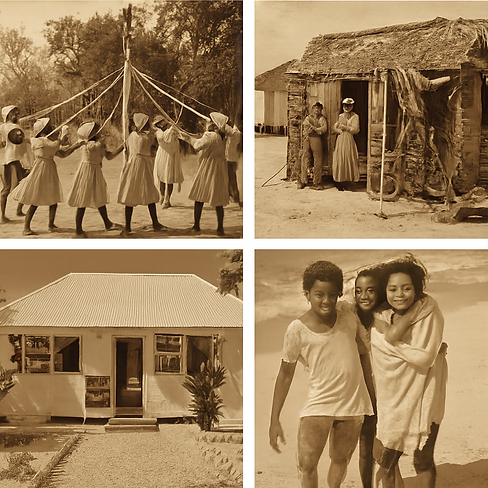
Marcia’s recollections highlighted a cultural framework deeply rooted in respect, communal responsibility, and tradition. Several themes emerge from her testimony:
-
Historical Anchors: The collapse of the turtling industry and the adoption of the 1972 Constitution significantly influenced Cayman’s economic trajectory and collective identity. (Cayman Compass, 2024).
-
Daily Customs: Practices such as formal greetings, elder care, communal cooking, and religious observance were integral to everyday life.
-
Community Roles: Elders functioned as keepers of cultural knowledge, while children were expected to contribute meaningfully to household and community activities.
-
Creative Expression: Music, dance, storytelling, and sports served as vital methods for intergenerational bonding and cultural communication.
-
Modern Shifts: Globalization, migration, and technological advancement have reshaped family structures, language use, and how younger generations engage with heritage. (Cayman National Cultural Foundation, 2024).


.webp)
.webp)
.webp)

.webp)
Three sociological concepts that provided a useful framework for analyzing the cultural shifts described in Marcia’s account were:
-
Socialization
Caymanian children were socialized through direct participation in family routines, religious instruction, and community practices. Tasks such as sweeping yards at dawn, attending church services, and learning traditional crafts demonstrated the spread of social norms through lived experience. -
Cultural Lag
Rapid modernization in Cayman has produced a gap between technological progress and cultural adjustment. The decline of oral storytelling, the erosion of formal greetings, and the reduced visibility of elders illustrate how certain traditions have not kept pace with societal change. (Government of the Cayman Islands, 2017). -
Collective Memory
Marcia’s voluntary work in her community and church embodies the concept of collective memory. By video-taping oral histories and reviving traditional dances, she seeks to preserve shared narratives, symbols, and rituals that constitute Caymanian identity. (Cayman National Cultural Foundation, 2024).

Marcia’s testimony extends beyond personal memory; I believe it represents a call to action regarding cultural preservation.
There is no question that the Cayman Islands have achieved notable economic development and global integration. However, I believe that our heritage, language, customs, and values require more attention on our part and deliberate stewardship.
Preserving Cayman’s past should not be seen as an act of resistance to change but rather a means of anchoring identity within shared memory. I confess, however, that the central challenge lies in ensuring that our cultural richness is not eroded by modernization but instead integrated into the evolving fabric of the Caymanian society.
Our class project is directly relevant to these themes because it engages us in the very process of cultural transmission and collective memory. By documenting, analyzing, and reflecting on cultural practices, we are not only studying change but also participating in preservation.
In this way, the project itself becomes an example of intentional stewardship. We are bridging academic inquiry with community heritage. It also reinforces the idea that cultural values must be actively woven into the future, and that education plays a vital role in sustaining identity across generations.
References
-
Marcia Ebanks. Member of the Cayman Islands Community
-
Cayman National Cultural Foundation. (2024, November). Cayman National Cultural Foundation expands strategic direction [Media release]. Cayman National Cultural Foundation. https://artscayman.org/wp-content/uploads/2024/11/MEDIA-RELEASE-Cayman-National-Cultural-Foundation-expands-strategic-direction.pdf
-
Government of the Cayman Islands. (2017). National culture & heritage policy and strategic plan for the Cayman Islands, 2017–2026. Ministry of Culture, with support from UNESCO. https://www.plancayman.ky/wp-content/uploads/2024/01/National-Culture-Heritage-Policy-and-Strategic-Plan-for-the-Cayman-Islands-final-draft.pdf
-
Cayman Compass. (2024, December 3). After 40 years, CNCF plans for a future rich in arts, culture, and heritage. Cayman Compass. https://www.caymancompass.com/2024/12/03/cncf-to-build-on-its-legacy-with-new-redevelopment-plan/